
Why Thermal Problems Rarely Occur at Individual Components
Why Thermal Problems Rarely Occur at Individual Components
– and why System Understanding is Crucial for Reliable Electronics
When thermal issues arise in power electronics projects, the focus often first turns to the individual component. Is the power semiconductor properly sized? Is the heat sink sufficient? Does a different package need to be chosen?
However, in practice, it becomes clear time and again: Thermal problems are rarely attributable to a single component. They usually arise from the interplay of several factors – and thus at the system level. Power applications are thermally tightly coupled overall systems. Power loss, heat distribution, printed circuit board, housing, cooling concept, and real operating profiles influence each other. A component becomes critical not because it "gets too hot," but because heat is not effectively dissipated or is unfavorably concentrated within the system.
A typical example is local hotspots. Although all components operate within their specifications, temperature peaks occur at certain points on the assembly. The cause is often uneven current distributions, parasitic effects in the layout, or thermal couplings between components that do not stand out when viewed in isolation. Additionally, thermal effects are not static. Load changes, switching events, or cyclic operation lead to temporally variable temperature distributions. What appears uncritical in a steady state can quickly become problematic under dynamic conditions – especially in continuous operation or at elevated ambient temperatures.
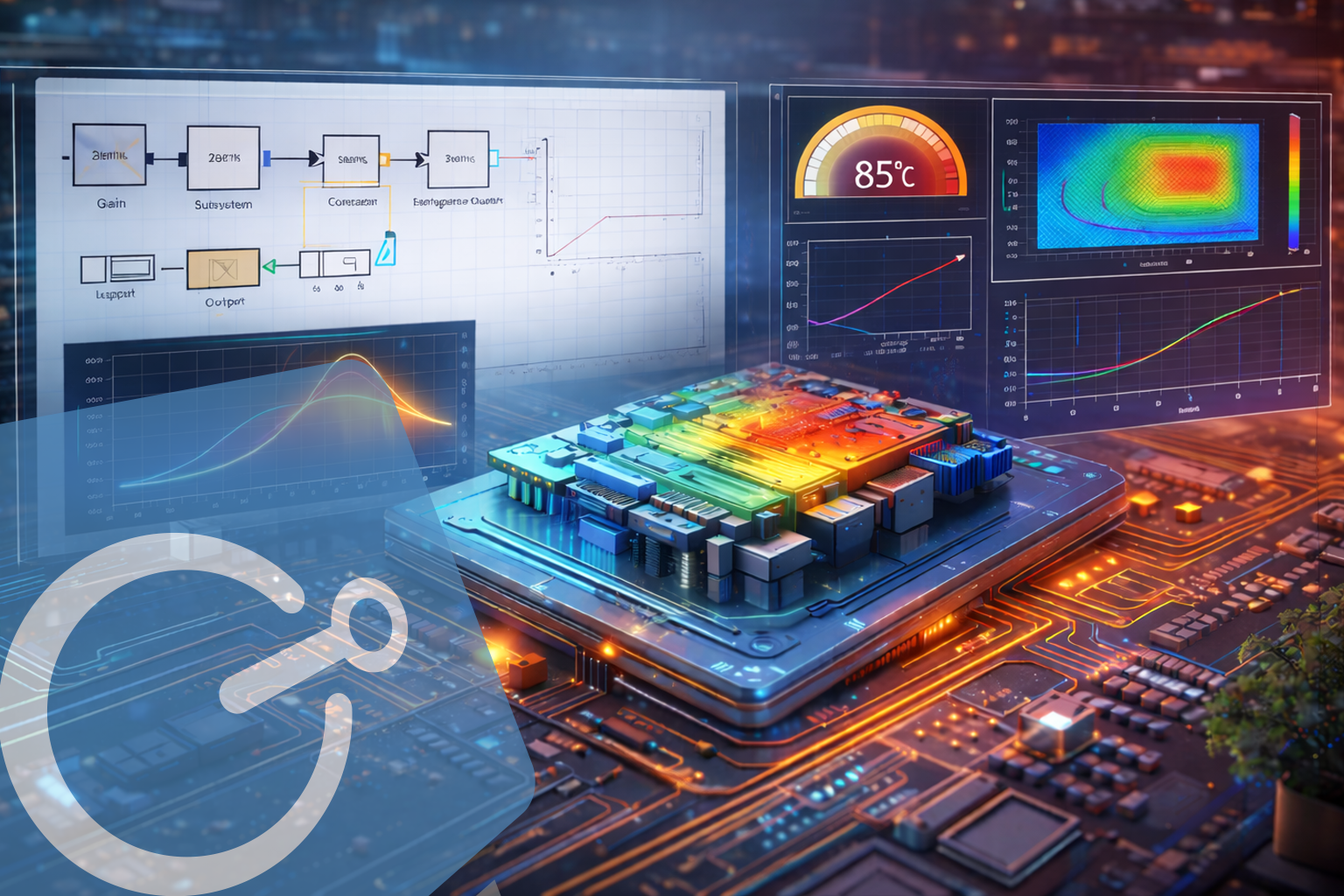
Another common misconception is the assumption that thermal problems can be solved by larger heat sinks or additional safety margins. In many cases, this merely shifts the problem without addressing the actual cause. At the same time, efficiency, space, and costs are lost. At CME, we therefore consider thermal issues fundamentally in the system context. Instead of evaluating individual components in isolation, we analyze the entire assembly in the interplay of electrical design, layout, mechanics, and real application. Simulations play a central role in making heat flows, hotspots, and critical operating states visible early on. This holistic approach allows us to address thermal risks where they actually arise – not at the symptom, but at the root cause. This enables targeted design decisions rather than blanket over-dimensioning.
The effect is evident throughout the entire product lifecycle. Thermally stable designs require fewer iterations, are more reproducible in manufacturing, and show higher reliability in the field. Efficiency, safety, and lifespan can thus be optimized together. For CME, thermal management is not a downstream testing step, but an integral part of development.
Only when thermal effects are understood systemically can electronic solutions be developed that function reliably under real conditions over the long term.
#ThermalManagement #PowerElectronics #ElectronicsDevelopment #Simulation #Reliability #CME